Invoice Requirements: All Mandatory Details in Austria and Germany
Contents 10 sections
- Invoice requirements in Austria under § 11 VAT Act
- Germany: mandatory details under § 14 UStG
- Invoice requirements: Austria and Germany compared
- Special cases that often go wrong
- E-invoicing: what is changing
- Invoice requirements: the most common mistakes – and how to avoid them
- Printable checklist of invoice requirements
- Payment terms, early-payment discounts and late interest
- Frequently asked questions
- Sources
An invoice isn’t just a payment request. For your client it is the basis for deducting input VAT; for you it is a document the tax office can audit for years. If a mandatory detail is missing, the client may lose their input VAT – and will send the invoice back. Here are the invoice requirements in Austria and Germany: what has to be on an invoice, where the two countries differ and which mistakes happen most often in practice.
Last updated: 01.11.2026. General information, not tax advice. Amounts and thresholds change – check the official sources linked below before important decisions.
Next step: 14-day free trial
Invoice requirements in Austria under § 11 VAT Act
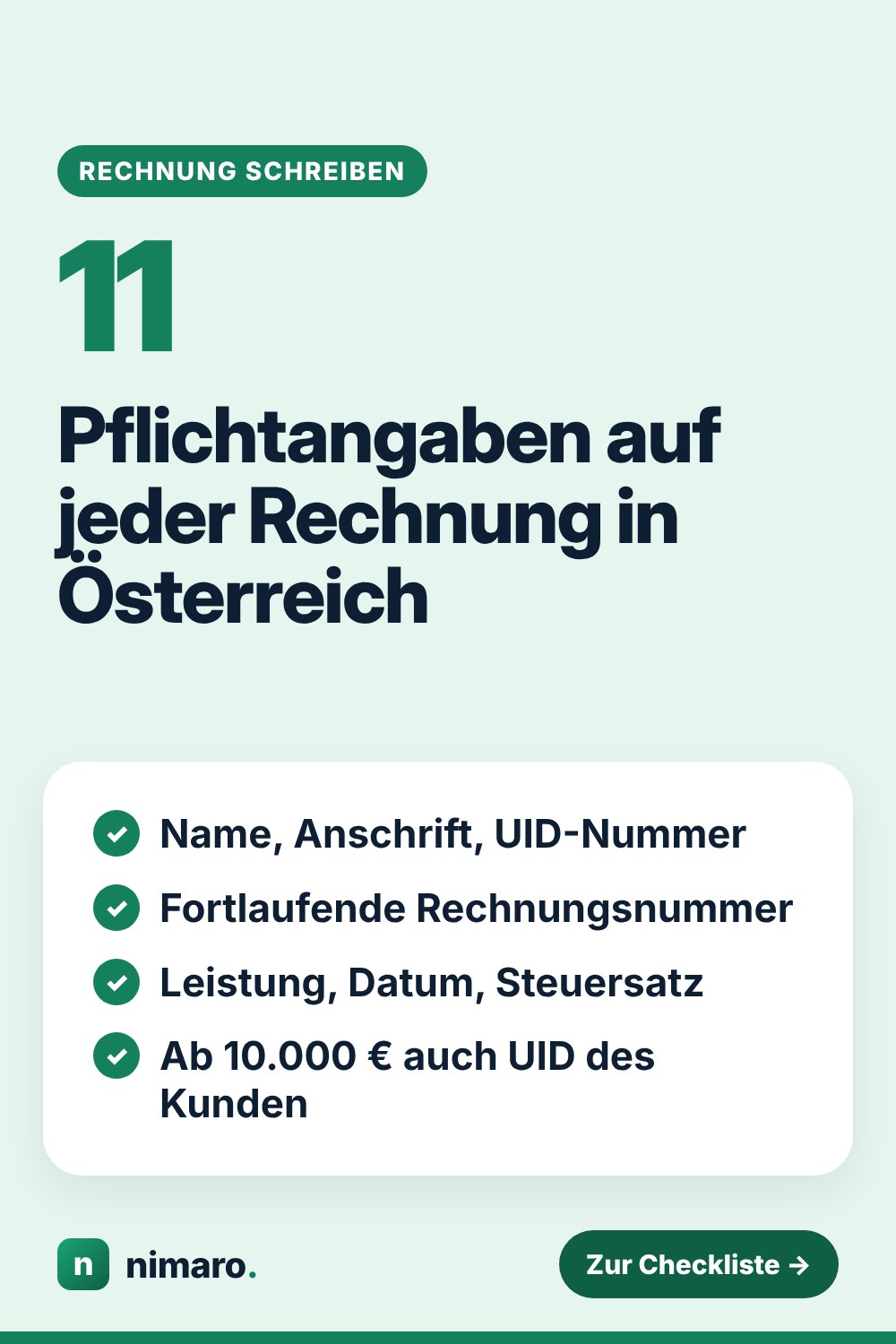
In Austria, § 11 of the VAT Act 1994 sets out what an invoice must contain. Exactly which details are needed depends on the amount. For a “normal” invoice above €400 gross:
- Name and address of the supplier – your business as registered in the company or trade register.
- Name and address of the recipient.
- Quantity and usual trade description of the goods, or type and extent of the service. “Various work” isn’t enough; “garden maintenance 12 hours, hedge trimming” is.
- Date of delivery or period of the service. Even if it matches the invoice date, state it explicitly.
- Net price and the applicable VAT rate; for exempt supplies, a note on the exemption.
- VAT amount in euros.
- Issue date.
- Consecutive invoice number that identifies the invoice uniquely. Several number series (e.g. per branch) are allowed as long as each number is used only once – see sequential invoice numbers.
- Supplier’s VAT number (UID).
- Recipient’s VAT number if the total exceeds €10,000 gross and the recipient is a business in Austria.
Small-amount invoices up to €400
For invoices up to €400 gross fewer details are enough: name and address of the supplier, quantity and description, date or period of supply, price and tax as one total (gross), the VAT rate and the issue date. Recipient name, invoice number and VAT number are not mandatory. Many businesses still number every invoice consecutively – it makes bookkeeping much easier. Details in small-amount invoices up to €400.
Germany: mandatory details under § 14 UStG
In Germany, § 14 (4) UStG sets out the mandatory details. They are similar to Austria’s, with some differences:
- Full name and address of supplier and recipient.
- Tax number or VAT ID of the supplier – in Germany the tax number is enough.
- Issue date and consecutive invoice number.
- Quantity and type of goods or extent and type of service.
- Date of delivery or service.
- Price broken down by VAT rate and exemption, plus any reduction agreed in advance (such as an early-payment discount).
- VAT rate and VAT amount, or a note on an exemption.
- For certain real-estate-related services to private individuals: a note on the recipient’s duty to keep the invoice.
In Germany the small-amount invoice is possible up to €250 gross (§ 33 UStDV). It needs the supplier’s name and address, issue date, quantity and type of service, gross price and VAT rate.
Invoice requirements: Austria and Germany compared
| Point | Austria | Germany |
|---|---|---|
| Legal basis | § 11 VAT Act 1994 | § 14 UStG, § 33 UStDV |
| Small-amount invoice | up to €400 gross | up to €250 gross |
| Supplier’s tax identifier | VAT number (UID) | tax number or VAT ID |
| Recipient’s VAT number | above €10,000 gross (domestic), always for intra-Community supplies and reverse charge | for intra-Community supplies and reverse charge |
| Retention | 7 years (§ 132 BAO) | 8 years for accounting vouchers such as invoices (§ 147 AO) |
Special cases that often go wrong
Small businesses
If you use the small business exemption, you show no VAT. Instead the invoice carries a note on the exemption – in Austria, for example, “VAT-exempt under the small business exemption”, in Germany a reference to § 19 UStG. If a small business shows VAT anyway, it owes that tax because of the invoice – with no input VAT deduction on the other side. How the scheme works is explained in our guide to the small business exemption.
Reverse charge and services to other EU countries
If you provide a service to a business in another EU country, the tax liability usually passes to the recipient. The invoice then shows no VAT, but both VAT numbers and the note “transfer of tax liability” (reverse charge). Check the client’s VAT number in the EU’s VIES system first and keep the confirmation – see reverse charge invoices.
Deposit invoices
If you ask for a deposit, you issue a separate invoice with VAT for it. On the final invoice you deduct the deposit together with its VAT. Forget this and the VAT is shown twice. Details in deposit and final invoices.
Correcting invoices
An invoice that has been sent is not deleted or overwritten. If a detail is missing or an amount is wrong, issue a correction or cancellation invoice referring to the original number and then a new invoice. That keeps the number sequence traceable.
E-invoicing: what is changing
In Austria, invoices to federal authorities have had to be submitted as structured e-invoices via the business service portal since 2014. Between businesses a PDF by email remains permitted if the recipient agrees.
In Germany, e-invoicing for transactions between domestic businesses has been phased in since 01.01.2025: all businesses must already be able to receive e-invoices; businesses with more than €800,000 turnover in the previous year must issue them (e.g. as XRechnung or ZUGFeRD) from 2027, all others from 2028. Exceptions apply to small-amount invoices and small businesses. If you invoice businesses in Germany, keep an eye on this – more in e-invoicing 2026.
Invoice requirements: the most common mistakes – and how to avoid them
- Missing date of supply. Always add it, if necessary “date of supply = invoice date”.
- Duplicate or jumping numbers from manually maintained Word templates. Software that assigns the number itself solves this for good.
- Vague descriptions such as “flat fee”. Better: what, how much, when.
- Wrong or missing VAT number, especially with clients elsewhere in the EU.
- VAT shown despite the small business exemption.
- Rounding differences between line items and the total. Calculate VAT on the net total per rate.
Printable checklist of invoice requirements
☐ My business name, address and VAT number · ☐ Client with address (in Austria above €10,000 also VAT number) · ☐ Invoice date · ☐ Consecutive number · ☐ Date or period of supply · ☐ Quantity and exact description · ☐ Net amount per VAT rate · ☐ VAT rate and amount or exemption note · ☐ Total · ☐ Payment terms and bank details
In nimaro there are fields for all these details, and the invoice number is assigned automatically. Before sending, check briefly that the date of supply and client details are filled in.
Payment terms, early-payment discounts and late interest
The payment term is not a mandatory detail, but it belongs on every invoice – otherwise it is unclear when the client is in default. A concrete wording with a date works best: “Payable by 15.12.2026 without deduction” is clearer than “payable within 14 days”. If you offer an early-payment discount, state percentage and deadline (“2 % discount if paid by 08.12.2026”); in Germany a reduction agreed in advance must even be stated explicitly on the invoice.
If a business client pays late, you can charge late-payment interest. Between businesses it is 9.2 percentage points above the base rate in Austria (§ 456 UGB) and 9 percentage points in Germany (§ 288 BGB). In both countries you are also entitled to a €40 flat fee for collection costs (§ 458 UGB and § 288 (5) BGB). Lower rates apply to consumers. In practice a friendly payment reminder usually pays off before a formal demand with interest – many open invoices have simply been overlooked.
Bank details and payment reference
Put your IBAN and BIC clearly on the invoice and ask clients to use the invoice number as payment reference. It sounds trivial, but it decides whether a payment can be matched to the right invoice automatically or whether you have to reconcile bank statements at month-end.
Frequently asked questions
Does an invoice have to be signed?
No. Neither Austria nor Germany requires a signature on an invoice. A PDF invoice without a signature is valid if it contains all mandatory details.
May the invoice number contain letters?
Yes. Any sequence of digits and letters is allowed as long as it identifies the invoice uniquely, e.g. “2026-0142” or “W-2026-17”. A gap-free sequence is not literally required in Austria, but it makes audits much easier.
From what amount must the client’s VAT number appear on an Austrian invoice?
When the invoice total exceeds €10,000 gross and the client is a domestic business. For intra-Community supplies and reverse-charge services it is always required.
Invoicing clients outside the eurozone? See invoicing in foreign currencies and exchange rates.
More practical guides for freelancers and small businesses in Austria: all nimaro guides.
Sources
- Austrian VAT Act 1994, § 11 – ris.bka.gv.at
- Austrian business service portal: formal requirements of an invoice – usp.gv.at
- German VAT Act, § 14 – gesetze-im-internet.de
- German VAT Implementing Regulation, § 33 – gesetze-im-internet.de
- German Federal Ministry of Finance: FAQ on e-invoicing – bundesfinanzministerium.de
Next step: 14-day free trial
You might also like

VAT Return in Austria: Deadlines, Periods and a Worked Example
Once you are VAT-registered, the tax office will be in touch regularly – with the VAT return, in Austria called the Umsatzsteuervoranmeldung (UVA). Many freelancers see it as a chore, …

Calculate Your Hourly Rate as a Freelancer: Formula and Worked Example
"What should I charge?" is probably the most common question at the start of self-employment. Many people take their former gross wage as an employee as a guide – and …

Avoid an SVS Back Payment: How the Self-Employed Build the Right Reserves
Your first year goes well, clients pay, your account grows – and then a letter arrives from the social insurance fund for the self-employed (SVS) demanding a back payment of …